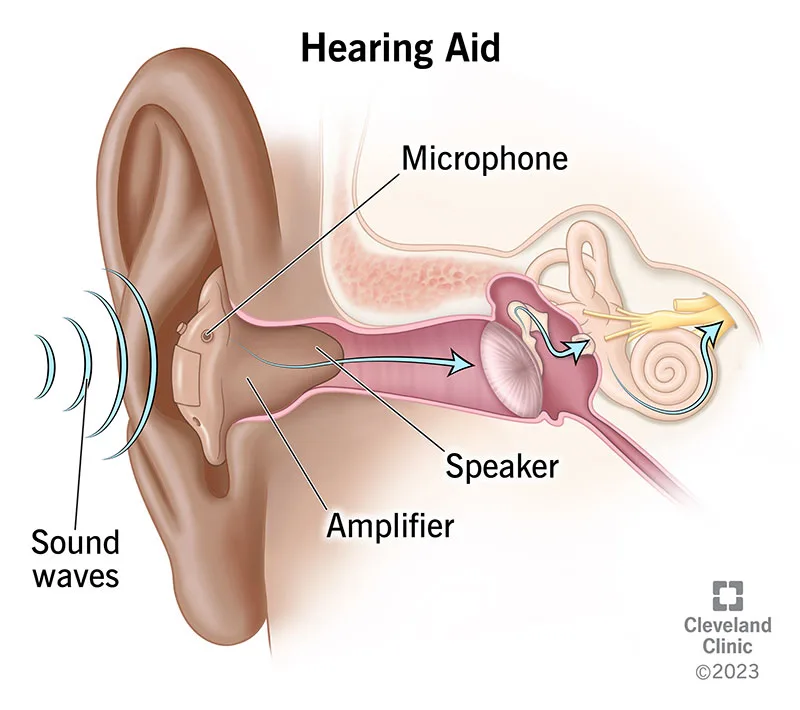
A hearing aid is a small electronic device worn behind or in the ear. It amplifies sounds so that a person with hearing loss can hear and understand speech better. It cannot restore natural hearing, but if you often strain to hear or ask people to repeat themselves, it can make everyday life much easier.
How a hearing aid works
Models differ, but the basic principle is the same:
- microphones pick up sound and turn it into an electrical signal;
- a processor handles the signal, and an amplifier makes it louder;
- a tiny speaker (receiver) delivers the sound to your ear.
Most modern hearing aids run on a rechargeable battery that you charge just like a smartphone. Some still use replaceable batteries.
Types of hearing aids
- Behind-the-ear (BTE) - the body sits behind the ear and sound reaches the ear through a tube.
- Receiver-in-the-ear (RITE) - a small body behind the ear, with the speaker in the ear canal.
- In-the-ear (ITE) - the device fills the outer bowl of the ear.
- In-the-canal (ITC) - a small device in the ear canal, almost invisible.
Which type suits you depends on your hearing loss, the shape of your ear and your daily habits. A specialist will help you choose.
Why a hearing aid should be fitted by a specialist
It all starts with a hearing test: it shows whether you have hearing loss and whether a hearing aid will help. The specialist then chooses a model, programs it to your audiogram and checks that it works as it should.
You can also buy cheap amplifiers online without a test, but you have to adjust them yourself, and at best they suit mild hearing loss. You also need to watch out for fakes - we wrote about this in Warning: counterfeit hearing aids are being sold online.
How long a hearing aid lasts
Usually 6-7 years. Hearing changes over time, so it is worth having it checked once a year: the hearing aid can then be reprogrammed instead of buying a new one. With significant hearing loss, the state pays for a new hearing aid once every 5 years - here is how to get it.
What a hearing aid gives you
- You hear conversations better, and many models can reduce background noise.
- For some people, ringing in the ears (tinnitus) eases. There are also models designed specifically for tinnitus.
- Research suggests that good hearing helps keep your thinking sharp and lowers the risk of social isolation and depression.
How to care for a hearing aid
- Use hairspray and other cosmetics before putting the hearing aid in.
- Keep it away from heat, frost, moisture, children and pets.
- Recharge the battery or replace it in good time.
- Switch the hearing aid off when you are not using it.
- See a specialist at least once a year for adjustment.
What to expect in the first months
Getting used to a hearing aid can take several months - that is normal.
- Have your ears cleaned before the hearing test. Earwax can get in the way of an accurate measurement.
- Your own voice will seem too loud. The microphones pick up your voice too. Most people get used to it within a couple of weeks, and you do not sound louder to others.
- Whistling or buzzing. Most often the hearing aid needs cleaning or adjusting, or it is not inserted correctly.
- Difficulty in noisy places. Background noise can often be reduced in the settings, but a loud environment is a challenge even for people with good hearing.
The main thing is not to give up and leave the hearing aid in a drawer. If something is not right, contact a specialist: an adjustment is usually enough.
Does a hearing aid help if you cannot hear at all?
It depends on the cause and severity of the hearing loss. If the inner ear is severely damaged, a hearing aid will not help, and a cochlear implant may be a better option.
Source: Cleveland Clinic - Hearing Aids.